Count usable inventory, not just items on a shelf
A reorder decision should consider usable stock, confirmed replenishment and existing commitments. A component already reserved for a shutdown is not freely available for another repair. Likewise, an unidentified or quarantined part should not be counted as usable stock.
Define the reorder point
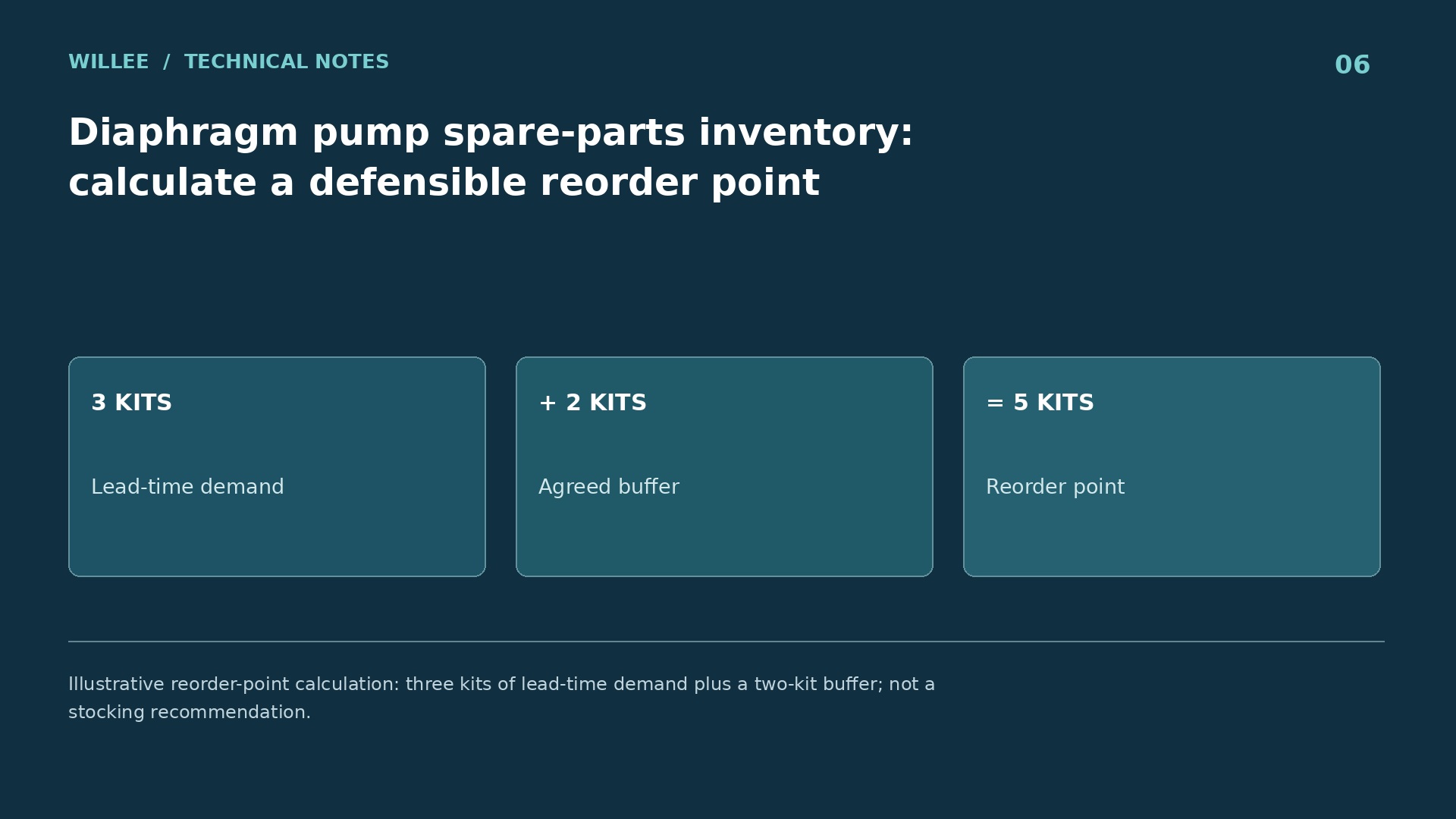
For a simple planning model, reorder point equals expected demand during replenishment time plus an agreed safety buffer. Inventory position equals usable on-hand stock plus confirmed on-order stock minus outstanding demand or allocations, taking care not to count an allocation twice.
Review for replenishment when inventory position reaches the selected trigger. This rule is an inventory policy, not a prediction of diaphragm life. It works only when the demand and lead-time assumptions are visible.
| Illustrative input | Value |
|---|---|
| Replenishment demand | 3 kits |
| Safety buffer | 2 kits |
| Reorder point | 5 kits |
| Inventory position | 4 + 2 − 1 = 5 kits |
Work through an example
Illustrative figures: expected consumption is two kits per month, replenishment takes six weeks, and the planning convention uses four weeks per month. Replenishment demand is 2 × 1.5 = 3 kits. With a two-kit buffer, the reorder point is five.
If usable stock is four, two kits are confirmed on order and one is committed, inventory position is 4 + 2 − 1 = 5. The trigger has been reached. The order quantity is a separate decision; it is not automatically five kits.
Treat rare critical parts differently
Average demand can be misleading for a rarely used component that can stop a critical line. For those parts, review outage consequences, standby capacity and replenishment uncertainty explicitly. Do not turn a zero-consumption history into an automatic zero-stock decision.
Recalculate the policy after a change in installed equipment, actual demand or supplier lead time. Keep manufacturer storage requirements and any shelf-life restrictions in the stocking decision. A mathematically neat reorder point is unhelpful if the inventory cannot be used.
Illustration: Illustrative reorder-point calculation: three kits of lead-time demand plus a two-kit buffer; not a stocking recommendation.
Related reading: Identify parts before maintenance.
Stock decisions should connect verified part numbers to downtime risk and replenishment time.
Contact WILLEEUse the instructions and specifications for the exact equipment configuration. This article introduces the selection discussion.