The beginning of a container transfer often looks uneventful. The final portion reveals whether the installation was designed for the whole batch: the source level falls, flow becomes less consistent and the operator has to decide when to stop.
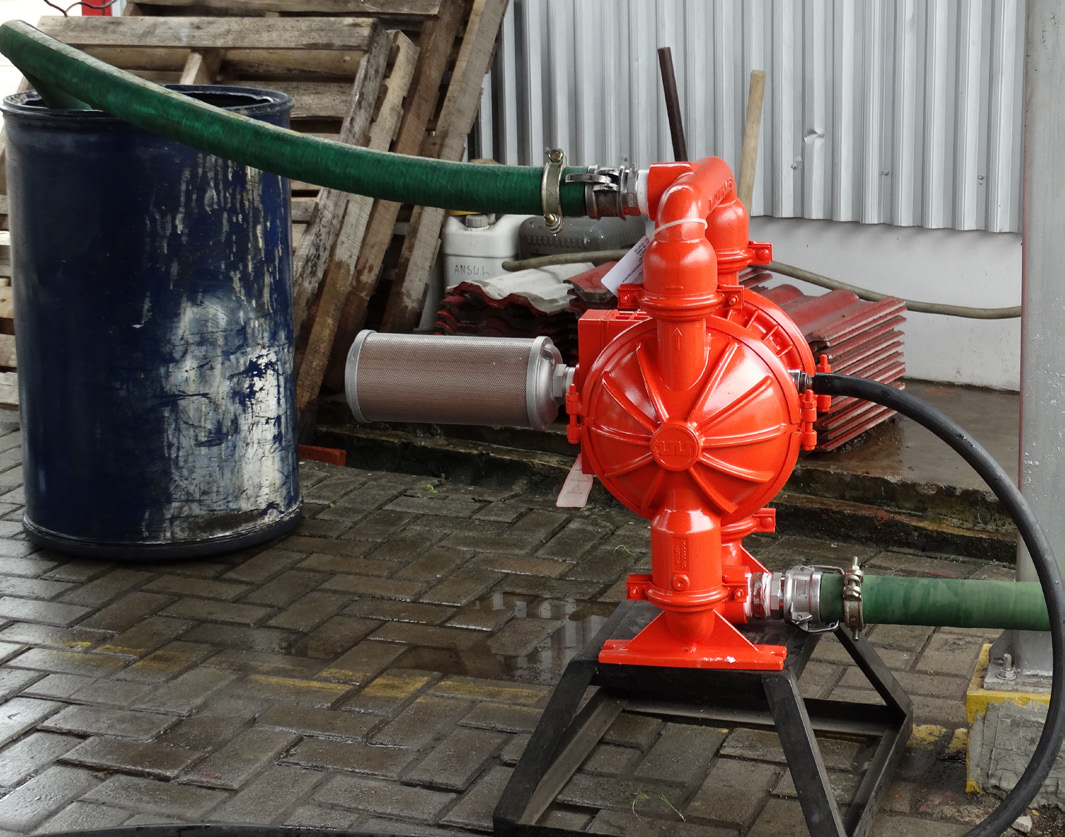
用于中型散货箱卸货的隔膜泵应在最低正常液位下进行评估。 用于桶卸货的隔膜泵的规格也应适用同样的终点问题,尽管集装箱连接和取料安排不同。
That decision affects both recovered product and utility use. Continuing to cycle after useful transfer has ended can consume air without moving meaningful liquid. Stopping too early leaves product behind. A reliable unloading arrangement needs an agreed end point and an inlet arrangement that remains workable as the vessel empties.
评估低位IBC卸料隔膜泵
For a pump drawing from above the liquid surface, the static lift changes as the level falls. For a bottom-connected IBC, the available positive head reduces. In either arrangement, the hose route, valve and actual connection bore remain important. A layout that works with a full container may become marginal near the end.
Keep the inlet route practical and identify high points where gas can collect. Check that the hose is suitable for suction service and cannot collapse under the expected conditions. A visible external diameter does not establish the hose's internal bore or suitability.
The container also needs an approved way to accommodate volume leaving it. Manufacturer safety guidance warns that inappropriate vessel ventilation can expose a container to damaging pressure conditions. For hazardous or contamination-sensitive fluids, use the vessel's engineered venting or closed-transfer arrangement; casually opening a lid is not a general solution. [R10]
将“空”定义为操作要求
Specify acceptable residual quantity and how it will be measured. The residual may include liquid in the container, pickup arrangement, pump and connected hose. Different measurement boundaries can make two installations appear to recover different amounts even when they deliver the same useful quantity downstream.
避免对完全排空做出笼统的承诺。 容器的几何形状、提取位置、产品粘附性和允许的搬运方法都会影响剩余容量。 改变容器的位置或使用临时提升装置来回收最后的液体并不能替代合适的卸载设计。
| End-of-batch issue | Evidence to collect | Possible engineering response |
|---|---|---|
| Flow falls before the expected end | Remaining source quantity and inlet condition | Review restriction, level and pickup geometry |
| 骑自行车加速与少交付 | 交付量和来源一级的趋势 | Review an approved empty-source stop method |
| 批次留下不一致的残留物 | Residual measurement with a fixed boundary | Standardize the unloading and measurement method |
| Transfer foams near completion | Observation of gas entry and return arrangement | Review the pickup and end-point strategy |
选择一个能回答正确问题的停止信号
液位传感器可以指示源已达到商定的液位,接收容器测量可以显示目标量到达,超流控制可以响应指定的异常循环条件。 这些功能相关但并不相同。
ARO lists level-control and over-run accessories for compatible installations. Their availability supports a more controlled unloading sequence, but selection still requires confirmation of the pump model, fluid environment and desired shutdown action. [R4]
循环计数本身就是一个不确定的空容器信号,因为当气体进入时,有效液体排量会发生变化。
Leave the system ready for its next batch
After transfer, follow the approved isolation, pressure-release and cleaning procedure. Account for trapped liquid before disconnecting a hose. Graco's operating instructions illustrate the need to relieve stored pressure and flush with a compatible medium where required; the exact sequence must come from the installed model's documentation. [R11]
For an unloading enquiry, send WILLEE the container outlet arrangement, fluid information, pump position, hose length and acceptable residual quantity. Those details reveal more than a request for “a pump for a 1,000-litre tank.”
Review a drum or IBC transfer arrangement
Technical references
[R10] Wilden / PSG. Safety Supplement to Engineering, Operation and Maintenance Manual.
[R11] Graco. 308981ZAZ: Air-Operated Diaphragm Pumps – Instructions.
[R4] ARO. Diaphragm Pump Controls.
应用照片是制造商的参考图像,而不是 WILLEE 客户项目声明。 具体型号的说明优先于这一一般工程讨论。
Select the pump against a documented transfer route and acceptance requirement.
讨论此事 Kevin请使用说明和规格来确定设备的确切配置。 本文介绍了选择讨论。