The beginning of a container transfer often looks uneventful. The final portion reveals whether the installation was designed for the whole batch: the source level falls, flow becomes less consistent and the operator has to decide when to stop.
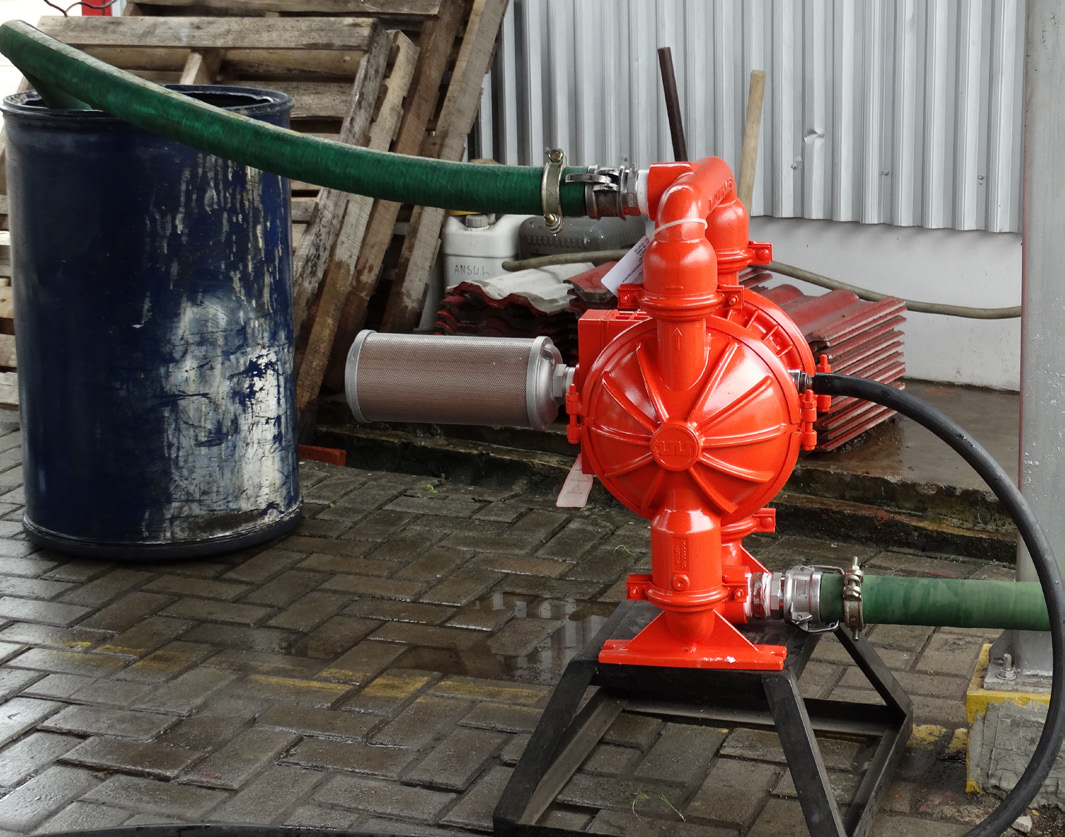
Les mêmes questions relatives aux points d ' échéance s ' appliquent lorsque l ' on spécifie une pompe à membrane pour le déchargement de fûts, bien que les raccordements des conteneurs et la disposition des prises diffèrent.
That decision affects both recovered product and utility use. Continuing to cycle after useful transfer has ended can consume air without moving meaningful liquid. Stopping too early leaves product behind. A reliable unloading arrangement needs an agreed end point and an inlet arrangement that remains workable as the vessel empties.
Évaluer une pompe à membrane pour le déchargement de GRV à bas niveau
For a pump drawing from above the liquid surface, the static lift changes as the level falls. For a bottom-connected IBC, the available positive head reduces. In either arrangement, the hose route, valve and actual connection bore remain important. A layout that works with a full container may become marginal near the end.
Keep the inlet route practical and identify high points where gas can collect. Check that the hose is suitable for suction service and cannot collapse under the expected conditions. A visible external diameter does not establish the hose's internal bore or suitability.
The container also needs an approved way to accommodate volume leaving it. Manufacturer safety guidance warns that inappropriate vessel ventilation can expose a container to damaging pressure conditions. For hazardous or contamination-sensitive fluids, use the vessel's engineered venting or closed-transfer arrangement; casually opening a lid is not a general solution. [R10]
Définir « vide » comme une exigence opérationnelle
Specify acceptable residual quantity and how it will be measured. The residual may include liquid in the container, pickup arrangement, pump and connected hose. Different measurement boundaries can make two installations appear to recover different amounts even when they deliver the same useful quantity downstream.
La géométrie du conteneur, la position de prélèvement, l'adhérence du produit et la méthode de manutention autorisée ont tous une incidence sur le volume résiduel. Changer la position du conteneur ou utiliser un dispositif de levage improvisé pour récupérer le dernier liquide ne peut pas remplacer une conception de déchargement appropriée.
| End-of-batch issue | Evidence to collect | Possible engineering response |
|---|---|---|
| Flow falls before the expected end | Remaining source quantity and inlet condition | Review restriction, level and pickup geometry |
| Le cyclisme accélère avec peu de livraison | Volume livré et tendance au niveau de la source | Review an approved empty-source stop method |
| Les lots laissent des résidus incohérents | Residual measurement with a fixed boundary | Standardize the unloading and measurement method |
| Transfer foams near completion | Observation of gas entry and return arrangement | Review the pickup and end-point strategy |
Choisissez un signal d'arrêt qui répond à la bonne question
Un capteur de niveau peut indiquer que la source a atteint un niveau convenu. Une mesure du récipient récepteur peut démontrer qu'une quantité cible est arrivée. Un contrôle de dépassement peut réagir à une condition de cycle anormale spécifiée. Ces fonctions sont liées mais pas identiques.
ARO lists level-control and over-run accessories for compatible installations. Their availability supports a more controlled unloading sequence, but selection still requires confirmation of the pump model, fluid environment and desired shutdown action. [R4]
Un compte de cycles en soi est un signal incertain de vide de conteneur, car le déplacement effectif du liquide change lorsque le gaz entre dans le réservoir.
Leave the system ready for its next batch
Après le transfert, suivre la procédure approuvée d'isolement, de décompression et de nettoyage. Tenir compte du liquide piégé avant de débrancher un tuyau. Les instructions d'utilisation de Graco indiquent la nécessité de décompressionner la pression accumulée et de rincer avec un fluide compatible si nécessaire; la séquence exacte doit être indiquée dans la documentation du modèle installé. [R11]
For an unloading enquiry, send WILLEE the container outlet arrangement, fluid information, pump position, hose length and acceptable residual quantity. Those details reveal more than a request for “a pump for a 1,000-litre tank.”
Review a drum or IBC transfer arrangement
Technical references
[R10] Wilden / PSG. Safety Supplement to Engineering, Operation and Maintenance Manual.
[R11] Graco. 308981ZAZ: Air-Operated Diaphragm Pumps – Instructions.
[R4] ARO. Diaphragm Pump Controls.
Les photographies d'application sont des images de référence du fabricant, et non des revendications de projets clients WILLEE.
Select the pump against a documented transfer route and acceptance requirement.
Discutez de cela avec KevinUtilisez les instructions et les spécifications pour la configuration exacte de l'équipement.Cet article introduit la discussion de sélection.