The beginning of a container transfer often looks uneventful. The final portion reveals whether the installation was designed for the whole batch: the source level falls, flow becomes less consistent and the operator has to decide when to stop.
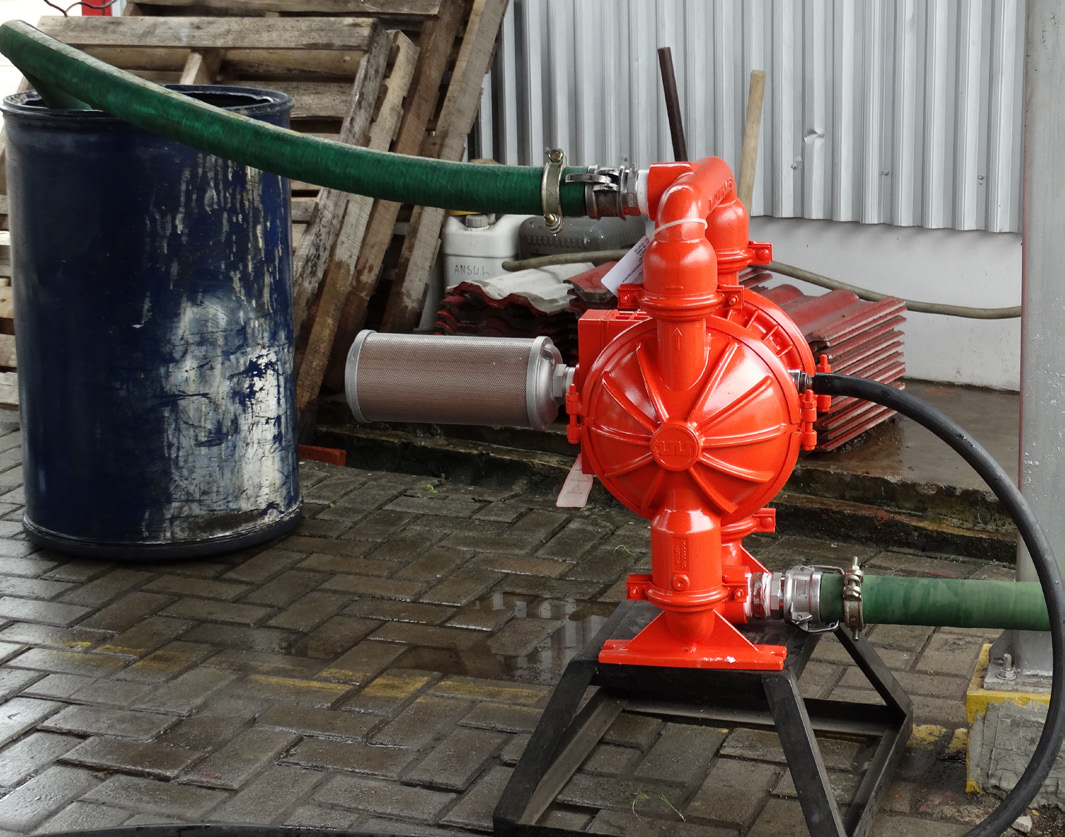
用於中型散貨箱卸貨的隔膜泵應在最低正常液位下進行評估。 用於桶卸貨的隔膜泵的規格也應適用同樣的終點問題,儘管集裝箱連接和取料安排不同。
That decision affects both recovered product and utility use. Continuing to cycle after useful transfer has ended can consume air without moving meaningful liquid. Stopping too early leaves product behind. A reliable unloading arrangement needs an agreed end point and an inlet arrangement that remains workable as the vessel empties.
評估低位IBC卸料隔膜泵
For a pump drawing from above the liquid surface, the static lift changes as the level falls. For a bottom-connected IBC, the available positive head reduces. In either arrangement, the hose route, valve and actual connection bore remain important. A layout that works with a full container may become marginal near the end.
Keep the inlet route practical and identify high points where gas can collect. Check that the hose is suitable for suction service and cannot collapse under the expected conditions. A visible external diameter does not establish the hose's internal bore or suitability.
The container also needs an approved way to accommodate volume leaving it. Manufacturer safety guidance warns that inappropriate vessel ventilation can expose a container to damaging pressure conditions. For hazardous or contamination-sensitive fluids, use the vessel's engineered venting or closed-transfer arrangement; casually opening a lid is not a general solution. [R10]
將“空”定義爲操作要求
Specify acceptable residual quantity and how it will be measured. The residual may include liquid in the container, pickup arrangement, pump and connected hose. Different measurement boundaries can make two installations appear to recover different amounts even when they deliver the same useful quantity downstream.
避免對完全排空做出籠統的承諾。 容器的幾何形狀、提取位置、產品粘附性和允許的搬運方法都會影響剩餘容量。 改變容器的位置或使用臨時提升裝置來回收最後的液體並不能替代合適的卸載設計。
| End-of-batch issue | Evidence to collect | Possible engineering response |
|---|---|---|
| Flow falls before the expected end | Remaining source quantity and inlet condition | Review restriction, level and pickup geometry |
| 騎自行車加速與少交付 | 交付量和來源一級的趨勢 | Review an approved empty-source stop method |
| 批次留下不一致的殘留物 | Residual measurement with a fixed boundary | Standardize the unloading and measurement method |
| Transfer foams near completion | Observation of gas entry and return arrangement | Review the pickup and end-point strategy |
選擇一個能回答正確問題的停止信號
液位傳感器可以指示源已達到商定的液位,接收容器測量可以顯示目標量到達,超流控制可以響應指定的異常循環條件。 這些功能相關但並不相同。
ARO lists level-control and over-run accessories for compatible installations. Their availability supports a more controlled unloading sequence, but selection still requires confirmation of the pump model, fluid environment and desired shutdown action. [R4]
循環計數本身就是一個不確定的空容器信號,因爲當氣體進入時,有效液體排量會發生變化。
Leave the system ready for its next batch
After transfer, follow the approved isolation, pressure-release and cleaning procedure. Account for trapped liquid before disconnecting a hose. Graco's operating instructions illustrate the need to relieve stored pressure and flush with a compatible medium where required; the exact sequence must come from the installed model's documentation. [R11]
For an unloading enquiry, send WILLEE the container outlet arrangement, fluid information, pump position, hose length and acceptable residual quantity. Those details reveal more than a request for “a pump for a 1,000-litre tank.”
Review a drum or IBC transfer arrangement
Technical references
[R10] Wilden / PSG. Safety Supplement to Engineering, Operation and Maintenance Manual.
[R11] Graco. 308981ZAZ: Air-Operated Diaphragm Pumps – Instructions.
[R4] ARO. Diaphragm Pump Controls.
應用照片是製造商的參考圖像,而不是 WILLEE 客戶項目聲明。 具體型號的說明優先於這一一般工程討論。
Select the pump against a documented transfer route and acceptance requirement.
討論此事 Kevin請使用說明和規格來確定設備的確切配置。 本文介紹了選擇討論。