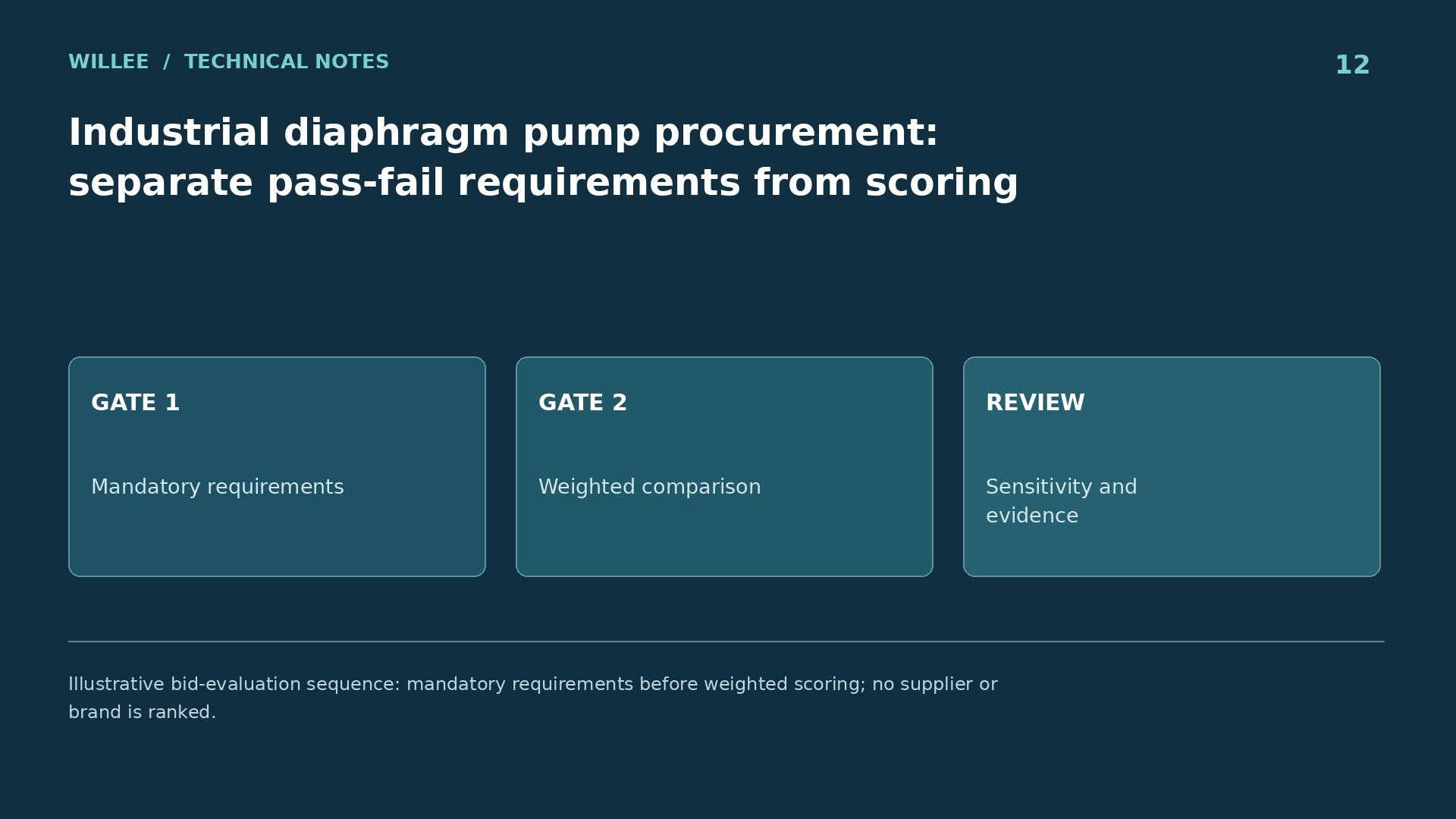
Why one combined score can mislead
A quotation with an attractive price should not earn its way around an unresolved mandatory requirement. When every factor is placed in one weighted table, a proposal can appear competitive even though its technical basis is incomplete. Use an eligibility gate first, then compare the proposals that pass. This is an illustrative evaluation method, not a ranking of pump brands.
Gate 1: define mandatory requirements
Identify the operating requirement, required materials, installation constraints and any essential documentation. State what constitutes acceptable evidence and who reviews it. Use three outcomes: pass, fail or unresolved. Do not silently convert an unanswered question into a pass.
Keep the requirement tied to the offered configuration. A document about a broad product family may be useful background but may not resolve the exact proposal. Record approved deviations explicitly so later reviewers do not have to reconstruct the decision from email fragments.
| Illustrative criterion | Weight | Score / 5 | Contribution |
|---|---|---|---|
| Evaluated cost | 40% | 4 | 1.6 |
| Confirmed delivery | 30% | 3 | 0.9 |
| Maintenance support | 20% | 5 | 1.0 |
| Documentation | 10% | 4 | 0.4 |
| Total | 100% | — | 3.9 / 5 |
Gate 2: score eligible proposals
Only after the mandatory review should the commercial comparison begin. Select criteria that matter to the project, define their scoring rules and set the weights before seeing the final result. Examples include evaluated cost, confirmed delivery, maintenance support and documentation completeness beyond the mandatory minimum.
A weighted score is the sum of each criterion score multiplied by its weight. If a five-point scale is used and weights total 100%, the overall result remains on that five-point scale. Keep the scoring direction consistent: a higher score should always mean a better result under the stated rule.
Work an illustrative comparison
Suppose the weights are cost 40%, delivery 30%, maintenance support 20% and documentation 10%. An eligible offer receiving 4, 3, 5 and 4 scores 4×0.40 + 3×0.30 + 5×0.20 + 4×0.10 = 3.9 out of 5.
These numbers do not evaluate any actual supplier. Their purpose is to show the arithmetic. A second offer cannot be judged fairly until the same scoring definitions have been applied. Avoid awarding a delivery score from an unconfirmed promise while assessing another supplier against a written commitment.
Test whether the decision is robust
Check how the preferred result changes if a reasonable alternative set of weights is used. If a small change reverses the decision, describe the choice as sensitive to those priorities rather than mathematically certain. Also compare the scope of supply: omitted accessories or service parts can make prices look more favorable without making the offer more complete.
Do not double-count the same benefit under several labels. For example, a verified service arrangement might influence a maintenance-support score, but should not automatically earn separate points for every related phrase in the quotation.
Release an auditable recommendation
Retain the mandatory review, scoring definitions, evidence references and the selected configuration together. The recommendation should identify unresolved commercial conditions and the person responsible for closing them. At order release, transfer the approved scope into the purchase order instead of referring only to the highest-scoring spreadsheet row.
This approach makes the decision explainable to engineering, purchasing and maintenance. It also provides a useful baseline for a later replacement project without implying that the same brand or scoring weights should win every application.
Illustration: Illustrative bid-evaluation sequence: mandatory requirements before weighted scoring; no supplier or brand is ranked.
Related reading: Compare pump quotations.
A documented chain from duty to delivery makes pump purchasing easier to verify and maintain.
Contact WILLEEUse the instructions and specifications for the exact equipment configuration. This article introduces the selection discussion.