Calendar life is an incomplete comparison
Two pumps can run for the same number of months while handling very different quantities of abrasive solids. Comparing replacement dates alone can therefore favor the less heavily used installation. Start by recording liquid throughput and, where reliable data exist, the mass of solids transferred.
Keep concentration units explicit
A solids fraction stated by mass cannot be substituted directly for a volume fraction. For a mass-based calculation, solids mass equals slurry mass multiplied by the solids mass fraction. If slurry mass is derived from volume, use a representative slurry density and document its basis.
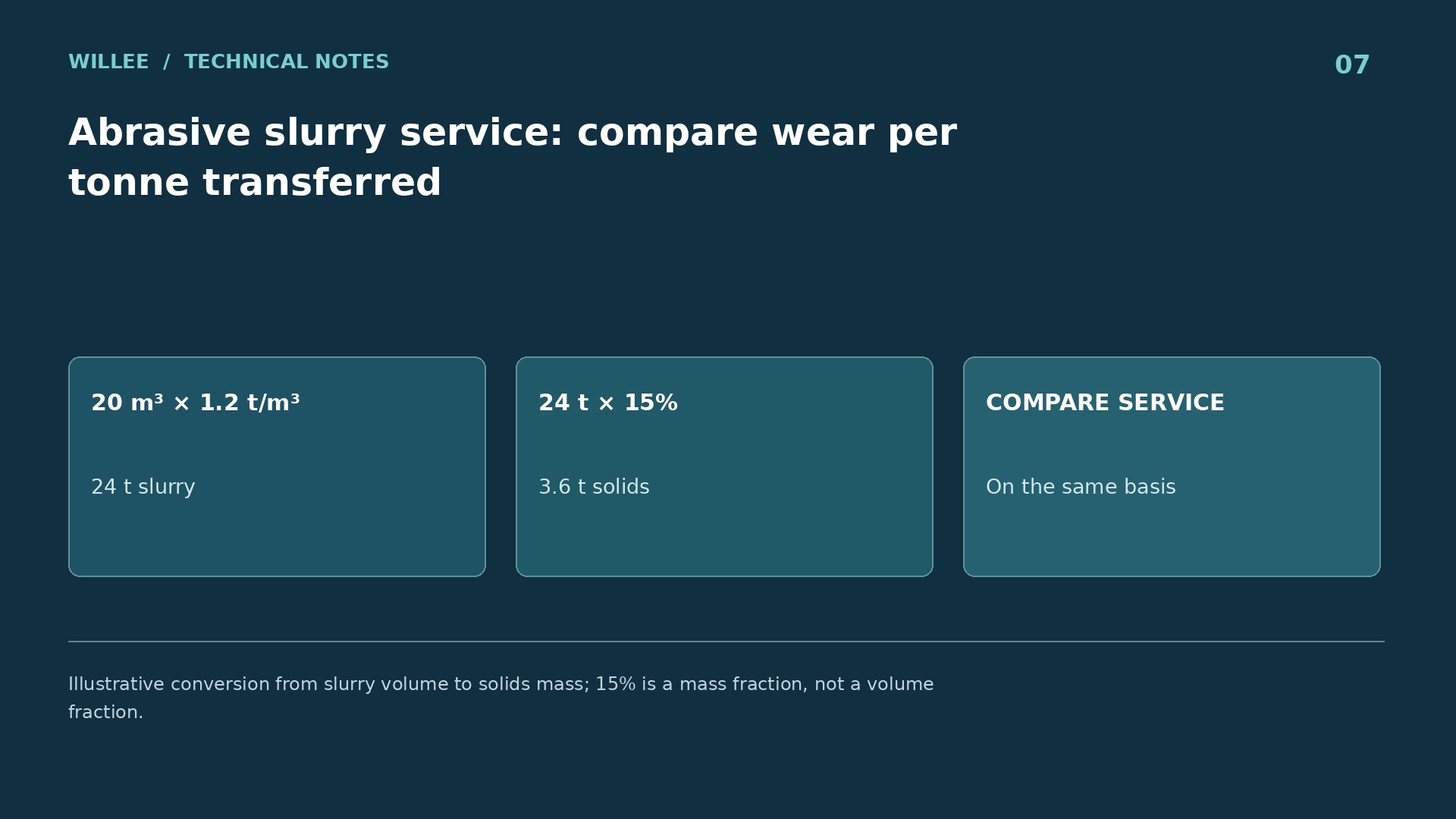
Illustrative example: 20 m³ of slurry at 1.2 tonnes/m³ represents 24 tonnes of slurry. At 15% solids by mass, it contains 3.6 tonnes of solids. This is an accounting example, not a pump capacity claim.
| Indicator | What it tells you | Main limitation |
|---|---|---|
| Months between repairs | Calendar interval | Ignores duty intensity |
| Replacements per throughput | Maintenance frequency relative to output | Needs consistent component coding |
| Cost per tonne | Defined maintenance burden | Depends on cost boundaries |
Choose a useful maintenance indicator
Record component replacements per defined throughput, or maintenance expenditure per tonne, using a consistent cost scope. Keep diaphragm, check-element and seat replacements separate if the data allow. A single “pump repair” entry conceals which component is determining the interval.
Do not confuse replacement frequency with a measured wear rate. Unless physical material loss is measured, describe the indicator as replacements or cost per throughput rather than millimetres of wear.
Control the comparison
Particle hardness, shape and size distribution, concentration, fluid chemistry and operating conditions can all change the service being compared. Record these differences instead of assigning every improvement to a new material. An observation period that ends before failure should be recorded as ongoing service, not as a completed lifetime.
Use the first set of records to establish a baseline, then review a proposed change against comparable duty. This method supports a maintenance discussion; it cannot guarantee service life from solids concentration alone.
Illustration: Illustrative conversion from slurry volume to solids mass; 15% is a mass fraction, not a volume fraction.
Related reading: Understand ball and flap valves.
A useful slurry enquiry describes variability and a test basis, not just a maximum particle size.
Contact WILLEEUse the instructions and specifications for the exact equipment configuration. This article introduces the selection discussion.