Executive summary
Une comparaison énergétique AODD doit répondre à une question de processus : combien d'entrées de service public sont nécessaires pour fournir une quantité convenue de liquide dans des conditions définies ?La comparaison des débits maximum ou des pressions de décharge du compresseur ne répond pas à elle seule.
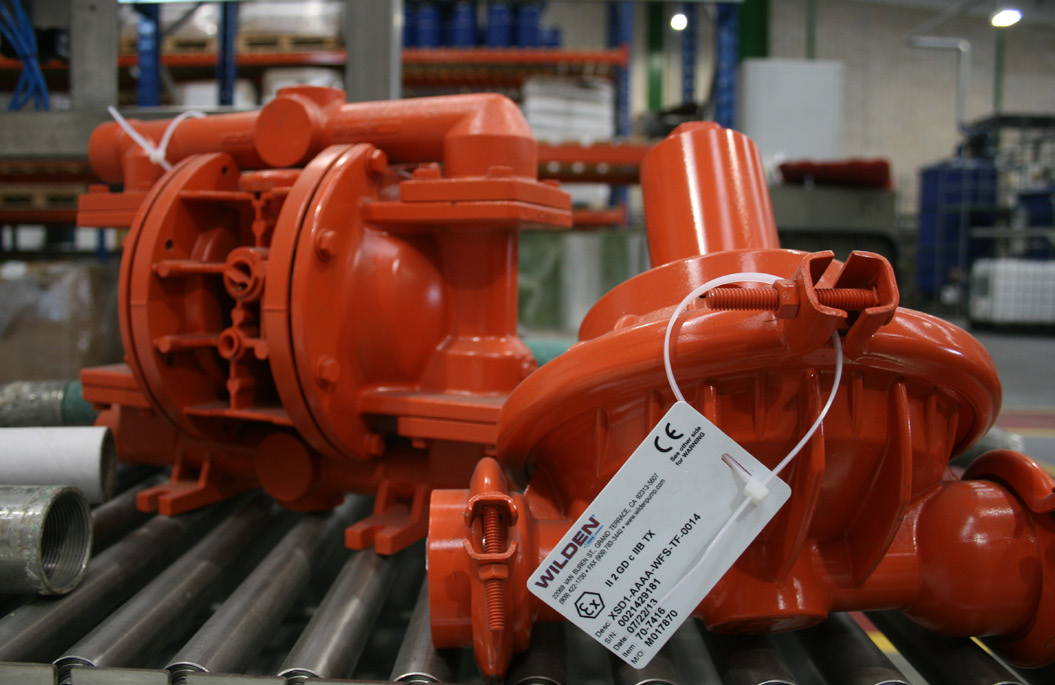
Avant de décider comment réduire la consommation d'air de la pompe à membrane, établissez une base de référence qui peut être répétée.
This paper provides a plant-level screening method using measured air volume, measured liquid output and an explicitly stated air-cost basis. It is not a certified performance test or a claim about a particular pump model. Its worked example uses assumed numbers solely to demonstrate the calculation.
1. Define the comparison boundary
Pour une comparaison portant uniquement sur une pompe, mesurez l'air fourni à cette pompe et le liquide livré par son système de sortie. Si la question concerne une chaîne de production, incluez la fuite de branchement pertinente, la consommation au ralenti et la séquence de fonctionnement à l'intérieur d'une ligne clairement décrite.
Keep the boundaries consistent between the baseline and proposed arrangement. It is misleading to charge all compressor-room losses to one option but compare it with only the drive input of another. It is equally misleading to attribute every reduction in air demand to an immediate reduction in compressor electricity.
La conception de la distribution d'air peut affecter la consommation. Wilden La réduction de l'admission d'air inutile vers la fin de la course de pompage dans le cadre de la Pro-Flo SHIFT Traiter une revendication de conception comme une raison de tester une configuration, plutôt que comme une garantie d'économies transférable. [R6]
2. Record a comparable operating condition
Identify the pump configuration, diaphragm and check-valve arrangement. Record fluid temperature, density and viscosity where available; inlet conditions; discharge pressure; and the normal operating sequence. The same nominal pump size can operate at different effective duties after a hose, valve or filter is changed.
Use an air meter suitable for the expected range and pulsating service, and document the installation requirements. State the reference pressure and temperature used for normalized air volume. Do not mix actual compressed volume, standard cubic feet and normal cubic metres without a documented conversion basis.
Measure liquid volume independently where possible, using an appropriate flow instrument or a calibrated collection method. Where mass is used, convert it using density at the relevant condition. A counter multiplied by a catalogue displacement can be a diagnostic estimate, but it should not silently replace measured delivery in a savings claim.
3. Diaphragm pump air consumption calculation
For a matched test interval:
Specific air consumption = normalized air volume / delivered liquid volume.
Express the result as Nm³ of air per m³ of liquid only when the chosen normal reference conditions are declared. A lower value means less measured air was used for the same delivered liquid quantity within that test boundary. It does not, by itself, describe product quality, transfer time or equipment life.
For an annual screening estimate:
Coût annuel de l'air = volume annuel de liquide × consommation d'air spécifique × coût de l'air alloué.
The allocated air cost should be supplied by the plant's utility team. It may include more than electrical energy. Label the basis so that different departments do not compare incompatible figures.
4. Worked example – assumed values, not field results
Suppose two acceptable operating arrangements each deliver 5 m³ of the same liquid at the required duty. The baseline consumes 150 Nm³ of air; the alternative consumes 120 Nm³. Assume annual liquid delivery of 6,000 m³ and an allocated air cost of USD 0.025 per Nm³.
| Quantity | Référence | Alternative |
|---|---|---|
| Liquid delivered in test | 5 m³ | 5 m³ |
| Normalized air used | 150 Nm³ | 120 Nm³ |
| Specific air consumption | 30 Nm³/m³ | 24 Nm³/m³ |
| Besoin annuel d'air à la puissance supposée | 180,000 Nm³ | 144,000 Nm³ |
| Coût annuel alloué des vols | USD 4,500 | USD 3,600 |
The assumed difference is 36,000 Nm³ of air and USD 900 per year on the selected allocation basis. Specific air consumption falls by 20%. These results follow from the assumptions; they are not a WILLEE test, a manufacturer guarantee or a forecast for an unidentified installation.
If the installed incremental cost were USD 3,000, a simple utility-only payback would be approximately 3.3 years. That excludes maintenance differences, installation disruption, financing and the time value of money. A purchasing decision should identify those omissions rather than hiding them inside an apparently precise return figure.
5. Separate air savings from electricity savings
The compressor's control strategy matters. Reduced pump demand may reduce loaded operating time, avoid starting another compressor or simply increase unloaded running. The electrical response can differ in each case. Ask the utility team to estimate marginal electricity savings from the measured change in demand, preferably with compressor power records.
L'information QUANTM de Graco décrit l'entraînement électrique et le potentiel d'économie d'énergie, mais un calcul sur site nécessite toujours un débit de fluide adapté et une entrée électrique mesurée ou justifiée. La bonne question n'est pas de savoir si un pourcentage de brochure est impressionnant, mais si la pompe proposée produit le rendement requis à un coût global du système inférieur. [R1]
6. Test the result before approving it
Repeat runs after steady operation is established, and include representative start, stop and emptying behavior if it matters to the production cycle. Keep raw measurements, instrument identification and the conditions for each run. A single favorable reading can conceal a change in source level or fluid temperature.
The comparison should report throughput and transfer time alongside utility intensity. Reducing pump speed may reduce instantaneous air use while extending the shift or missing the production target. Check that every candidate meets the same acceptance conditions.
For a first uncertainty check, compare the size of the claimed improvement with meter accuracy and run-to-run variation. Do not report decimal-level savings when the input readings or air-cost allocation are only approximate. State whether the economic result is a screening estimate or a measured operating comparison.
7. Practical decision record
Conservez des photographies du raccordement à l'air et de la tuyauterie de liquide installés; ces éléments facilitent la reproduction des comparaisons ultérieures. Les directives d'installation de Wilden insistent sur l'évitement des restrictions inutiles en matière de tuyauterie, qui peuvent autrement confondre une comparaison de pompes. [R7]
WILLEE can help structure an enquiry using the pump code, flow requirement, discharge condition and available utility measurements. A credible energy proposal begins with a reproducible duty, not an unsupported promise of a fixed percentage reduction.
Discutez d'un avis sur l'énergie AODD
Technical references
[R6] Wilden / PSG. Optimizing Air Usage in AODD Pumps.
[R7] Wilden / PSG. PS8 Plastic Engineering, Operation and Maintenance Manual.
[R1] Graco. QUANTM Electric Double Diaphragm Pump.
Les photographies d'application sont des images de référence du fabricant, et non des revendications de projets clients WILLEE.
Télécharger le livre blanc technique (PDF)
Comparez le coût par transfert utile en utilisant des conditions correspondantes et une base de volume d'air documentée.
Discutez de cela avec KevinUtilisez les instructions et les spécifications pour la configuration exacte de l'équipement.Cet article introduit la discussion de sélection.