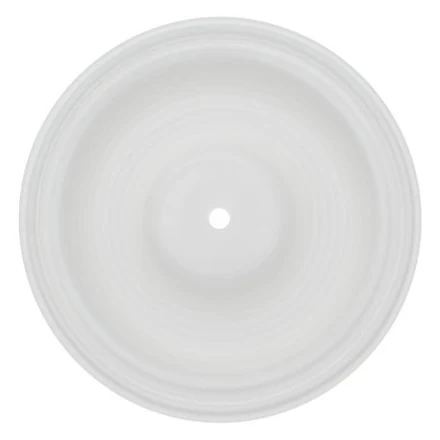
Start with the installed pump
A WILDEN diaphragm order needs more than the port size and the word PTFE. Record the complete nameplate model, the diaphragm part number and the relevant exploded-view reference. Photograph the nameplate and both sides of the removed component after the equipment has been safely isolated and cleaned. Keep each photograph attached to the same equipment record.
This guide addresses replacement identification. For a broader comparison of material families, read our PTFE, EPDM and TPE diaphragm guide.
Separate material, design and supply scope
| Check | What to record | Why it matters |
|---|---|---|
| Material | Wetted-face material and any separate backing | A material label does not identify the complete assembly. |
| Design | Reduced-stroke, full-stroke or integral-piston construction, as documented | Different designs can require different associated components. |
| Supply scope | Individual diaphragm, backing component or complete wet kit | The quoted line must cover the components actually required. |
| Installed configuration | Full pump code and manufacturer parts-list revision | Nominal size alone cannot establish interchangeability. |
Wilden offers rubber, thermoplastic elastomer and PTFE material families. Its PTFE range includes different stroke designs and backing combinations. Use the WILDEN diaphragm brochure to identify the design family, then use the manual for the installed pump to confirm the assembly.
A concrete part-number example
WILDEN 02-1010-55 is listed as a reduced-stroke PTFE diaphragm for a nominal 1-inch pump. That description identifies a particular component; it does not approve the part for every 1-inch WILDEN pump. Confirm the backing and assembly reference before ordering it.
If several wet-side wear components are required, compare the individual parts list with the WILDEN wet-kit selection guide. Check each included item and quantity instead of assuming that a package photograph defines its contents.
Check the process as well as the fit
Prepare the fluid name, concentration, operating and cleaning temperatures, and any abrasive solids information. A mechanically correct replacement still needs a material review for the actual exposure. When the service has changed, make the change explicit in the enquiry rather than repeating the previous order without review.
For a failed diaphragm, retain a cleaned sample and a record of the operating conditions. Our failed-diaphragm evidence guide explains how to organize that record. Installation sequence, tightening values and commissioning checks must come from the manual for the exact configuration.
Send a checkable replacement request
- Complete pump model and nameplate photograph.
- Diaphragm part number, quantity and existing backing identification.
- Manual reference and whether the request is for an individual part or a kit.
- Process fluid, concentration, temperature and required delivery destination.
Contact WILLEE for a configuration and availability check. See also our pump and spare-parts FAQ.
Keep the pump code, diaphragm part number and backing specification together in the purchase record.
Contact WILLEEUse the instructions and specifications for the exact equipment configuration. This article introduces the selection discussion.