A new shaft is not the whole inspection
When a shaft is removed during authorized maintenance, the useful question is not simply whether it looks worn. Its mating surfaces and associated components also belong in the inspection record. Record the shaft, bushings or sleeves, seals and diaphragm plates as applicable to the design.
Use location-based observations
Photograph each component before cleaning removes evidence. Identify the position of scoring or discoloration, the direction of marks and the corresponding contact region. A photograph without a location reference is difficult to compare at the next service.
Where the manual specifies a dimensional check, record the instrument, measurement location and result. Do not create a universal shaft diameter, clearance or rejection limit across pump families. Acceptance must come from the relevant service criteria.
| Record field | Example entry format |
|---|---|
| Location | Component and marked contact region |
| Observation | Description without assumed cause |
| Measurement | Value, unit, location and instrument |
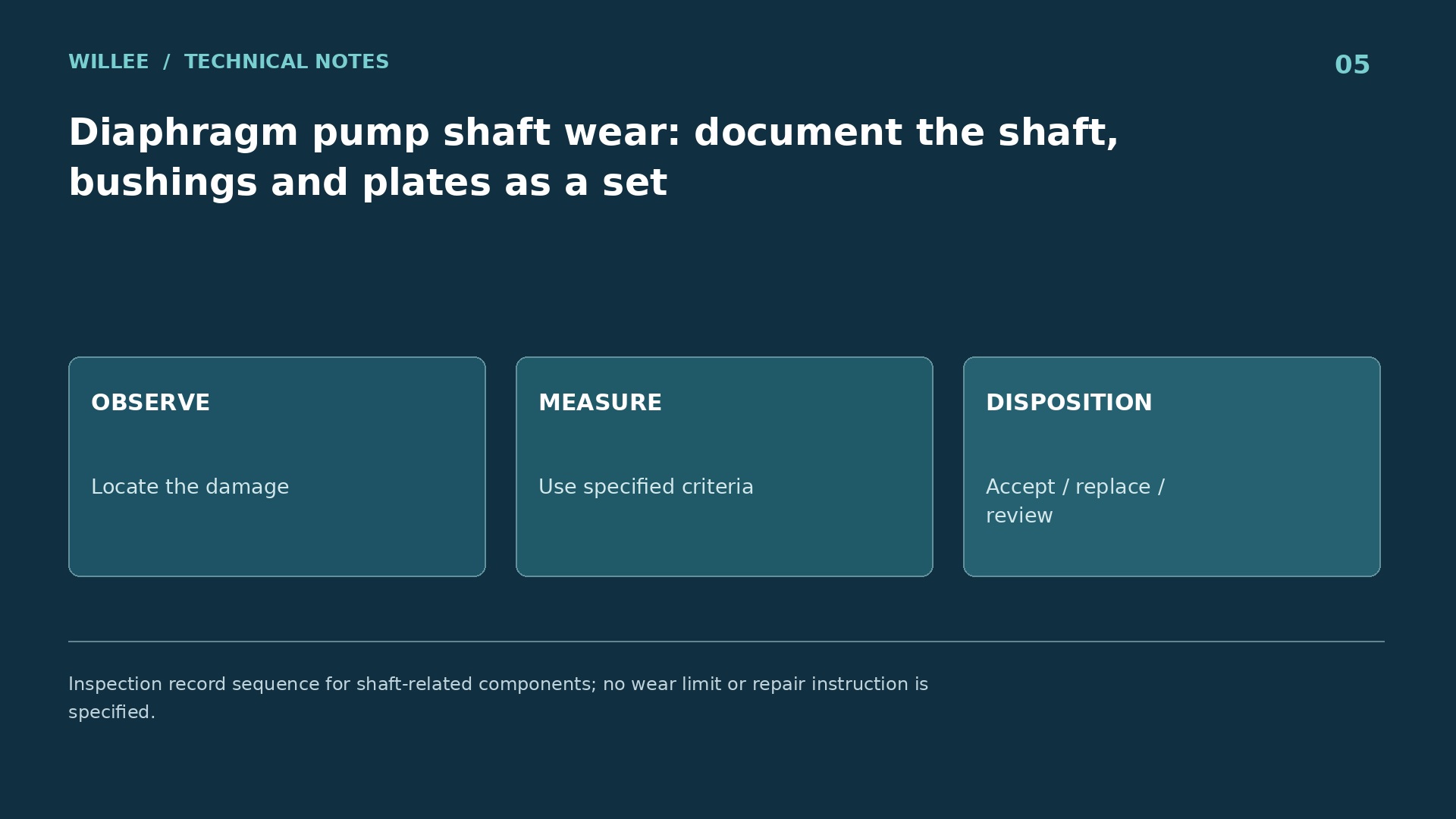
| Disposition | Accept / replace / technical review |
Separate observation from explanation
“Longitudinal marks near the seal contact area” is an observation. “Contamination caused the wear” is an explanation that needs supporting evidence. Preserve both fields separately. Other observations, such as debris, damaged sealing edges or an affected mating surface, may help the technician assess a pattern without turning it into a premature conclusion.
Avoid polishing, straightening or modifying a component merely to make it look reusable. Any permitted rework must be supported by the manufacturer’s procedure.
Close the record with a disposition
Assign a disposition to each inspected component: accepted against the stated criterion, replaced, or held for technical review. Identify the person making the decision and the source of the criterion.
A repeat failure can then be compared by operating time and location rather than memory. The value of the record is not the number of photographs; it is the ability to connect physical evidence, the acceptance rule and the maintenance action.
Illustration: Inspection record sequence for shaft-related components; no wear limit or repair instruction is specified.
Related reading: Keep maintenance records by model.
A drawing-based list makes less-visible components easier to order accurately.
Discuss this with KevinUse the instructions and specifications for the exact equipment configuration. This article introduces the selection discussion.