Describe what is actually in the liquid
“Slurry” can mean fine suspended powder, abrasive grit or larger particles that quickly settle. Those are different duties. Record the largest particle, approximate solids concentration, shape and settling behavior before comparing pump families. Add the viscosity at working temperature and explain what happens during a production pause.
Look beyond the connection diameter
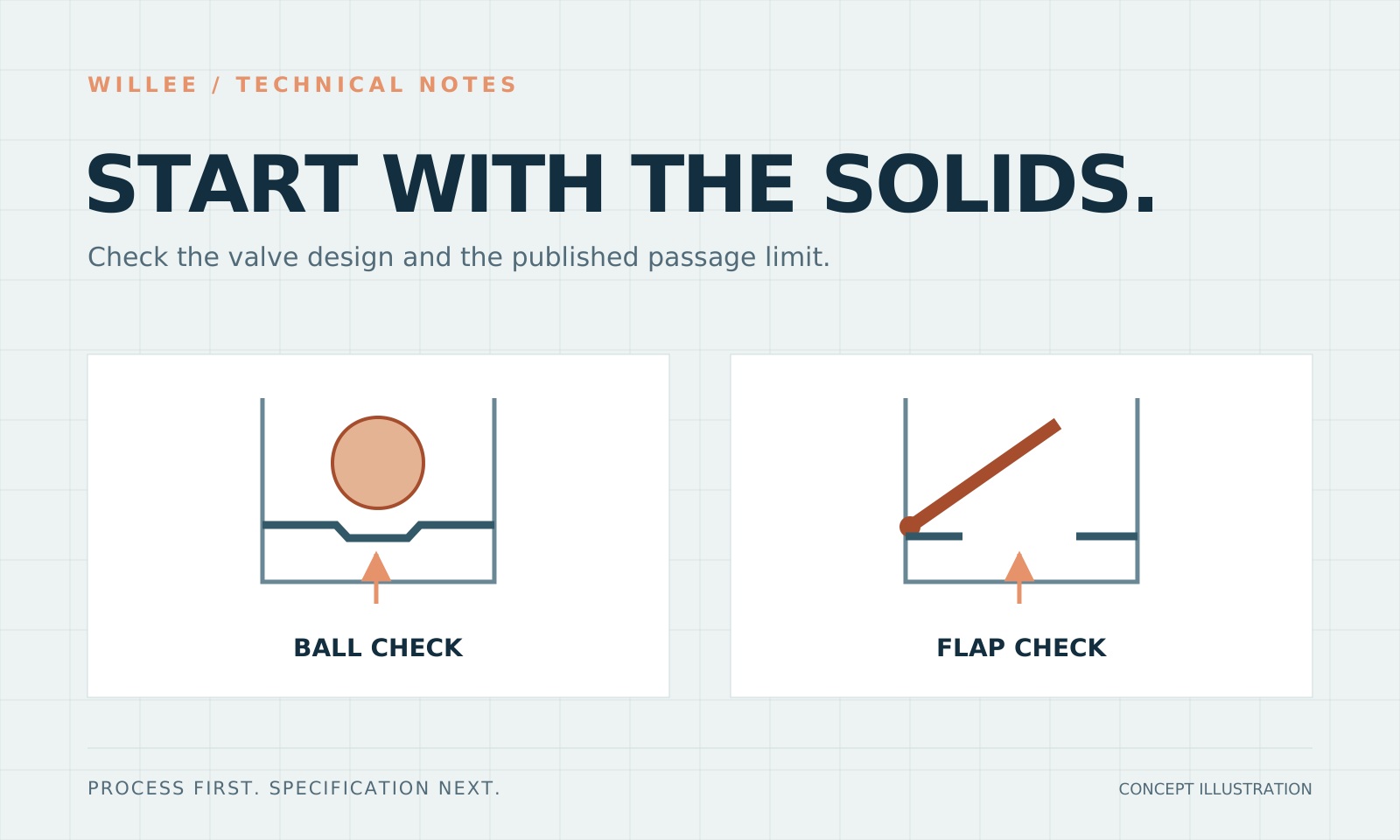
The liquid port size does not, by itself, establish the size of solid that a pump can pass. Internal passages and the check-valve arrangement matter. Ball valves and flap valves control direction differently, so a valve-material field should only be used once the valve construction is known. A flap-valve pump should not be assigned an invented “ball material.”
Use the family description to narrow the search
SANDPIPER distinguishes heavy-duty ball pumps for viscous, solids-laden duties from heavy-duty flap pumps for large or fast-settling solids and abrasive slurries. Its flap-pump range also uses construction features intended to help clear solids. Those family descriptions are a starting point: check the published passage limit and wetted materials for the exact model. SANDPIPER pump families · Heavy-duty flap pumps.
Include the installation in the brief
Sketch the suction line and the location of the pump relative to the vessel. Describe how settled material is handled and how the system is flushed. Ask for the relevant model specification instead of applying a passage rating from another pump in the same brand. Keep the selected valve construction in the maintenance record alongside the elastomer and body materials.
Specify the solids and verify the exact passage limit. Port size alone is not a solids rating.
Discuss this with KevinUse the instructions and specifications for the exact equipment configuration. This article introduces the selection discussion.