Filter-Press Feed Pumps: Evaluate the Whole Pressure Cycle
Select a diaphragm pump for filter press feeding across initial filling, rising resistance and the required final pressure condition.
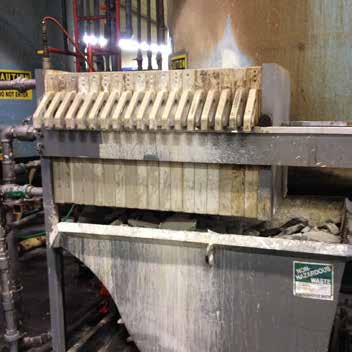
A filter press does not present one fixed operating point throughout a batch. Early filling may call for substantial flow at relatively low resistance. As solids accumulate and the cake develops, resistance changes and the available flow at a given pressure can fall.
A diaphragm pump for filter press feeding must match the required operating envelope. The choice between a conventional arrangement and a high-pressure AODD pump follows from the press duty, not from the industry name alone.
Selecting a feed pump only from the initial fill rate overlooks the later part of the cycle. Selecting it only from a maximum pressure can leave the plant with an unnecessarily slow filling stage. A useful enquiry describes both ends of the duty and the transition between them.
Define the duty of a diaphragm pump for filter press feeding
Record the initial filling requirement, the normal pressure progression and the permitted final feed pressure. Identify the slurry's solids loading, particle characteristics, temperature and any change during the batch. The press manufacturer should define the allowable feed conditions and operating sequence.
Review the pump curve against that envelope rather than using the largest number in a catalogue. Maximum flow and maximum discharge pressure are not simultaneous operating values. The installed system also includes the feed line, valves and any elevation difference between the source and the press.
| Stage | Process question | Pump-selection implication |
|---|---|---|
| Initial filling | How quickly must the press be filled? | Check delivery at the starting resistance |
| Cake formation | How does pressure rise as filtration progresses? | Check performance through the changing duty |
| Final filtration | What end pressure and stop criterion are required? | Confirm capability and controlled termination |
| Cycle completion | How will the system be isolated and depressurized? | Coordinate the pump and press operating procedures |
Know when pressure intensification is relevant
Wilden's high-pressure AODD range uses a different pressure-intensifying arrangement from a conventional 1:1 pneumatic design. Its published application guidance identifies filter-press service as a use case and distinguishes early filling from the higher-pressure requirement that can develop later. [R14]
That does not mean every press needs a high-pressure pump. Obtain the real pressure requirement first. If it exceeds the capability of an existing standard pump, do not attempt to create the required discharge condition by exceeding its permitted air supply. Select equipment and all connected components for the actual envelope.
A stopped pneumatic pump may still contain trapped pressure. Pressure balance at the end of a cycle is not evidence that the feed line or press is safe to open. The system's approved pressure-release procedure remains essential. [R10]
Use published cases as context, not design data
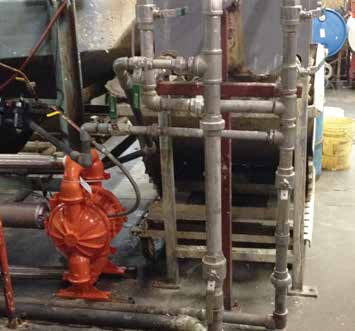
Wilden's AMTROL application report describes diaphragm pumps feeding sludge from manufacturing operations to filter presses. It provides a documented example of the application, but the dimensions, slurry and control sequence of another press cannot be inferred from that report. The photographs accompanying this article are application references from that manufacturer publication, not a WILLEE installation. [R15]
For your own system, measure cycle time and throughput together with final solids condition where that is part of the process objective. A pump change that improves filling time may not shorten the complete filtration cycle if the limiting factor lies elsewhere.
Agree the completion logic
Possible end-point inputs include pressure, filtrate flow, elapsed time or the press controller's sequence. The appropriate logic is application-specific. Define what the pump should do when the limit is reached, how restart is prevented during press opening, and what happens after an interrupted cycle.
When requesting a pump proposal from WILLEE, include the press operating envelope, slurry data, required fill time and current cycle observations. That supports a proposal for the full filtration duty rather than a pump selected from a single pressure or flow value.
Discuss a filter-press feed duty
Technical references
[R14] Wilden / PSG. High-Pressure AODD Pumps.
[R15] Wilden / PSG. AMTROL Improves Filter Press Reliability and Efficiency with Wilden Pro-Flo SHIFT.
[R10] Wilden / PSG. Safety Supplement to Engineering, Operation and Maintenance Manual.
Application photographs are manufacturer reference images, not WILLEE customer-project claims. Model-specific instructions take precedence over this general engineering discussion.